Every Michael Bay Movie, Part 11 – Lionel Richie, Do It To Me (1992)

Every Michael Bay Movie, Part 11 – Lionel Richie, Do It To Me (1992)

I attended high school in an era when music videos were still a thing. In Edmonds-Woodway High School homeroom, which occurred after lunch every day, my classmates and I would pay mild attention to VH1 and MTV while catching up on homework. This is where English teacher Bruce Mindt introduced me to the “2 second rule” of music videos. He pointed out that in no music video was there a longer than 2-second shot of anything. He would sit in the back of the room and annoy us all by shouting “one thousand one, one th-, one thousa-, one thousand one, one thousand tw-, one thousand one…” restarting his cadence every time the camera cut to another shot.

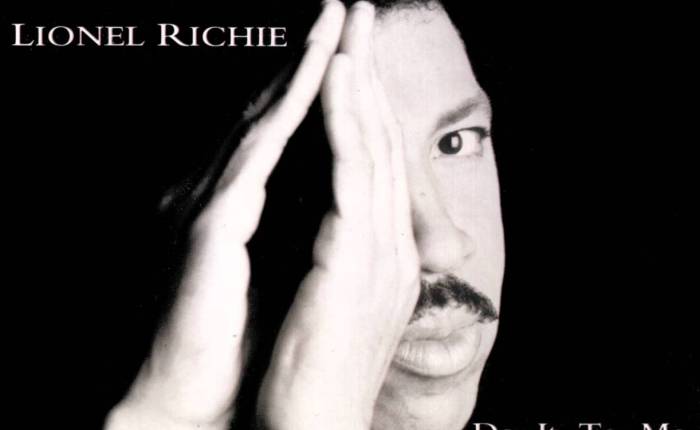
Michael Bay’s direction of Do It To Me is as good an example as any of this principle. The song clocks in at a modest 95 bpm, but the camera is constantly crashing between black and white and color, close and wide shots, women and men.

The thematic interest is paid to Richie, shot entirely in black and white, and his various female love interests, shot all in color. He is dressed simply in black, while she appears in a series of tantalizing gowns and flowing sheets. I suppose the video might have been “romantic” or even “sexy” to a person of the incredibly awkward early 90s, perhaps mostly because it sensualizes a set of black women in a sepia-based color palette that can’t have been common on television at the time.

Richie’s music is clearly white-people music. He was the whitest, yachtiest, soft-core-iest member of the otherwise funky Commodores, and he made a living clashing a jeri curl and a bushy mustache and overtly sexual lyrics with smooth, unthreatening sounds. He’s the type of black person America was comfortable with in 1992, as was Will Smith, a common component of Bay’s earlier films.

It’s tough to derive in hindsight whether Bay’s involvement with performers like this is an example of “pushing the envelope” within a society that we now look back on as pretty darn racist, or if he could have paid attention to more subversive or challenging black themes. His music videos consistently capture black artists playing white music (Richie), white artists playing black music (Vanilla Ice), otherness (The overt sexuality of the Divinyls, the bestial foreignness of Meatloaf), and strong women (Wilson Phillips).

Bay doesn’t seem like an envelope pusher when you look at his movies, but there is subversion to every one, from the complicated government / military themes in Bad Boys II and The Rock, to the symbolic, difficult love stories in Armageddon and Pearl Harbor.

In an era where America is challenged to confront whether they prefer a brash, challenging populist or an unexciting wonk who works within the system to get things done for President, it’s fun to think about the ways a mainstream movie director can tell us stories about the way we live our lives, especially when we aren’t overtly challenged to think about it.

He never has and probably never will stop making popcorn movies, but his work within the popcorn movie medium reminds me of the disrespect many people still give video games and comic books when they are referred to as storytelling devices. The medium outweighs the content.

Next: The Island

Every Michael Bay Movie, Part 8: Armageddon (1998)

Every Michael Bay Movie, Part 8: Armageddon (1998)

Armageddon (1998)

Budget: $140 Million

Box Office Gross: $553.7 Million

Rotten Tomatoes Rating: 39

Number of Explosions: 14


“I don’t know what you people are doing down there. But we got a hole to dig up here.”

The thing I found most interesting about Armageddon was the attention paid to the distance between the characters from each other. The distance between the asteroid and earth. The emotional distance between Grace and her father. The distance between A.J.’s crash-landed shuttle and the other space shuttle manned by Harry. And throughout the film, characters say things like,

“Do you think it’s possible that someone else in the world is doing this very same thing at this very same moment?”

“Why are you listening to someone 100,000 miles away? We’re here.”

Armageddon remarks on closeness and asks, to return to the themes of Michael Bay, what motivates people to do what they do.

But you probably don’t think of Armageddon that way. You probably think of it as a stupid, mindless action movie riddled with plot holes and emblematic of the summer movie culture, shat out by Hollywood entire to cash in on mindless dupes who just want somewhere air-conditioned to eat their popcorn.

And you know what? You have a point. You know that scene in every action movie in which everything doesn’t quite go to plan? Armageddon asks, “what if we made an entire movie out of that moment?” Things go awry, from the first scene on an offshore oil rig to the final moment, and for every moment in between for 3 hours. It’s exhausting to watch.

I’ve never really been compelled by arguments that point out scientific or logical inconsistencies in a movie plot. Each movie has to create a set of events and characters that exist in imagination rather than in reality, otherwise they’d all be documentaries. And in a fictionalized world of a movie the writers can create anything they want, for all I care. With respect to the famous criticism of Armageddon: couldn’t they have just trained a team of astronauts to drill, rather than train a team of drillers to astronaut? This is actually addressed in the plot of the movie. In the Armageddon universe, it is so hard to drill that it’s actually easier to train the drillers to go into space. Who cares if this is true in reality?

On the other hand, a disaster movie like Armageddon has to be based in some sense of reality because the entire premise is to make us as an audience imagine the dread of a world-ending event like a meteor hitting the earth. From that perspective it has to have more in common with the real world than Star Wars or one of those Marvel movies. And there are so many things in Armageddon that feel purely imagined that it makes it hard to focus on what is happening in the movie itself.

Yet, Armageddon has some things going for it – and most of those things can be attributed to Michael Bay.

First of all, Bay finds out how to squeeze tons of exposition into just a few minutes of screen time in order to focus a majority of the film on action. There’s the scene on the oil rig, which has its own bit of action, when we learn about Harry Stamper (Bruce Willis) and his crew, and A.J. (Affleck) and his relationship with Grace (Liv Tyler), Harry’s daughter. There is a one or two minute scene where Stamper gathers his entire team of drillers in a montage that tells us about who they are and what they like to do with their spare time. Then there’s another minute or two where we see A.J. and Grace together. That’s about it.

Yet the critical mission of the film’s plot takes off merely halfway through the movie and we spend a majority of the film watching the events in space. And as an audience we need to care about those moments we spent with the characters earlier in the film because we need to want A.J. to make it home to Grace. And we need to feel Harry’s sacrifice when he chooses to stay behind spoiler alert and detonate the bomb.

Does it work? Probably not for everyone. A critic would say that all of those action twists and turns could have been better spent establishing character. But the script has so much to chew through, and Armageddon is about watching our working class heroes overcome adversity in one situation after another.

The other thing that I noticed when watching Armageddon (which I last saw in a movie theater with my first girlfriend when I was 13 years old) was how important color was to this movie. I don’t know that the color is supposed to signify anything but there is a great deal of creativity employed with the lighting in Armageddon to create scenes that are doused in striking color. In the scene where Harry convinces Grace that he needs to go into space to solve this problem, Willis is somewhat normally lit, but Tyler’s frame is completely colored in green. In the moment you don’t think much of it because it’s probably some special space command light in the NASA terminal, but it’s an odd and abstract choice for a personal moment between two characters.

The Asteroid itself, computer generated and ominous, is generally surrounded by a purple hue. In fact, space itself is quite starkly lit in Armageddon, perhaps a nod to the otherworldliness of the setting, or perhaps a trick used to make a set look less, well, set-like. This use of color is remniscient of Divinyls’ I touch myself video (previously reviewed here) which also addresses the alien-ness that can be represented by color.

The use of color is key. It may not indicate an underlying lesson, but it does signify craftsmanship. It is a choice that didn’t have to be made when the movie was directed, edited, and shot. And stark differences in color and light typically symbolize other-ness. The theme of distance mentioned above is crucial.

What is more important? Physical distance or emotional distance? How is closeness developed? What kind of connection do people have when they are miles apart? Armageddon suggests that closeness means more than distance, and that there is a force in the universe more important than space and time. Remember 2015’s Interstellar, directed by the acclaimed Christopher Nolan? Is Armageddon really worse than that? Or was it just created by a more derided artisan?

So you may not like Armageddon, plot holes and all, but if you don’t, I think it’s likely that you should blame the writers instead of Michael Bay, who did in fact employ some artfulness in creating it. You know who was on the writing team? Sci-Fi wunderkind J.J. Abrams (who in my opinion still hasn’t written a satisfying movie).

Anyway, It is not always a joy to watch, but it isn’t stupid. And that’s the thing I am curious about. How did Michael Bay get characterized as a director of mindless cinema?

Next: Pearl Harbor
Every Michael Bay Movie, Part 7: The Rock (1996)

Every Michael Bay Movie, Part 7: The Rock (1996)

The Rock – 1996

Budget: $75 Million

Box Office Gross: $335.1 Million

Rotten Tomatoes Rating: 66

Number of Explosions: 6


“It’s on a need to know basis. And you don’t need to know.”

Every character in The Rock is keeping a secret from others. And every character in The Rock is having information withheld from them. The plot, each character arc, and the theme of the movie cover the power and authority that come with holding information that others lack.

Ed Harris’ General Hummel threatens to release chemical weapons in San Francisco, killing millions. The audience knows that he doesn’t intend to hard anyone. But the threat of danger is his secret, and the secret is what gives him power.

Hummel’s motivation? Frustration that the USMC won’t pay reparations to families of Marine special operatives who died performing secret missions. Harris’ knowledge of the secrets of these operatives is what makes him take extreme actions.

Every character has a secret agenda. Nic Cage’s Stanley Goodspeed constantly lies, to his girlfriend, to his counterpart John Mason (played by Sean Connery), and later to the FBI about Connery’s fate. These lies give him the free will to act as he chooses. When he is at risk of being found out, like when he tells the obvious lie that he has combat and anti-terrorism training, he is in danger of retribution. But as long as he maintains his secrets he is powerful, as powerful as if the lie were true.

Again we come to the difficult intersection of the director and the long list of specialists who work on a movie. The Rock is expertly written by Douglas Cook and David Weisberg and they are the ones who put these motivations into the minds of their characters as well as the words that help the audience understand them. But Bay is the one who chooses how and when to reveal these motivations, through staging and dialog and imagery. Again, never the one for subtlety, he shows a character’s pants literally catching on fire at one point. But he also shows Harris’ struggle with maintaining his threat while carefully avoiding hurting anyone.

Bay interned briefly for Steven Spielberg on the set of Raiders of the Lost Ark*, (and famously thought the movie was going to be terrible) and seems to have picked up a lot from Spielberg’s storytelling methods. While Bay is not sentimental in the same way Spielberg is, their technical approach to showing the characteristics of a scene are quite similar.

*By the way, check out Steven Soderbergh’s beautiful version of Raiders which has been stripped of all sound and color and re-scored to the electronic music used in Soderbergh’s television show The Knick. It is surprisingly engaging and not at all hard to follow even without any dialog. A great study in composition and visual storytelling. 

What we interpret as scenes and pictures with our minds are actually a series of pictures. When you look at the something your eye is rapidly and constantly scanning the surroundings and taking snapshots and your brain pieces the snapshots together to create what you interpret as an image. Some filmmakers choose to leverage this natural capability of the human brain by creating complex painting-like compositions that describe an entire scene in a single picture. Think of George Miller’s Mad Max: Fury Road where each frame is a tremendously complex and beautiful work of art.

Michael Bay (and to an extent, Spielberg) take more of an abstract approach, replicating your eye/brain process by actually showing you each individual chunk that makes up a larger scene. In a Michael Bay action scene, or even in a conversation, the camera is constantly showing you new things. A close up of a character. A piece of scenery. An object. The space between characters. A different angle. Another angle. Light pouring in from a window. You get a sense of space and time and motion that doesn’t exist in any single frame but does exist as a composition of shots. This is purist filmmaking.

This is a decidedly less “beautiful” approach than employing a cinematographer to capture intensely focused and massive establishing photographs and each picture fails to take your breath away. But it is a wonderfully effective way at telling a story that respects time as well as space in a medium like film. Bay is an excellent communicator and whether he knows it theoretically or not he has a precise understanding of how humans like their information paced and distributed to best understand a moment.

This expert dispersal of knowledge is almost a meta-narrative when combined with The Rock‘s themes of knowledge and authority. The skill would rarely be described as an art but  the amount of technical and intellectual expertise required to master it is truly artistic in nature. Note that the heroes of The Rock are masters of knowledge – Goodspeed because of his expertise relevant to the diffusion of the film’s chemical McGuffins, and Mason whose entire life has been about spycraft and access to hidden information.

People who succeed are those who have special knowledge that no one else has. When others learn their secrets, they can be threatened. A surprisingly topical lesson considering 2016’s issues of privacy, disclosure, and access to information.

“Losers try their best. Winners go home and fuck the prom queen.”

Next: Armageddon

Every Michael Bay Movie, Part 6: Bad Boys (1995)

Every Michael Bay Movie, Part 6: Bad Boys (1995)

Bad Boys – 1995

Budget: $19 Million

Box Office Gross: $141.4 Million

Rotten Tomatoes Rating: 43

Number of Explosions: 4


“I make movies for teenage boys. Oh dear, what a crime” – Michael Bay

Bad Boys is a great example of why I think Michael Bay is an interesting filmmaker. It is remembered mostly as an action/comedy that launched Will Smith’s career as a leading man. And while there is plenty of action it is decidedly less action-y than I would expect based purely on Michael Bay stereotypes. In fact, for most of the movie, the action is intentionally muted.

While there are a fair number of scenes where characters are shooting at one another, you rarely see a gun actually go off. The action is loud and the screen is full of smoke and flashes and different camera angles, but the explosion emanating from the barrel of the movies many rifles, shotguns, and pistols is nowhere to be seen (at least for the movie’s first 90-or-so minutes – at the end there is an extensive shoot out where all bets are off with respect to violence and weaponry. But even then there is less on-screen violence than you might expect).

I think this is clearly an intentional decision. Which is why it’s important to digress briefly to talk about what a director of a movie does:

The director of a movie does everything, but also nothing. They are in charge of all of the elements of the film’s creation, but work through a variety of specialists. Cinematographers, Editors, Lighting Technicians, etc all execute the specific tasks associated with a movie’s production but the director creates the vision and also makes sure the final product adheres to that vision. They also manage the actors and try to assure that the screen performances match their imagination of the movie’s script.

Because of this, it’s difficult to know whether cutting away from the true firing of guns in Bad Boys was part of Director Bay’s vision or not. It could be something that the editor did for some reason, or if they had a major shortage of ammunition on set and couldn’t get budget for more blank rounds, or if there was a licensing issue on the set they rented that prohibited firing weapons, or something else. It’s also worth noting that this was Michael Bay’s first feature film, and Jerry Bruckheimer was probably managing the production pretty closely, so some of the decisions could be credited to Jerry rather than our friend Mike.

But back to this anomaly in Bad Boys; I think it is quite notable because Bay has such a reputation for sacrificing story and artistry in favor of bold action set pieces and in this movie there is a clear pulling of punches when it comes to weapon use. Also notable – Julie, played by Tea Leoni, is passionate about animal rights and mentions her vegetarianism and reluctance to hurt animals multiple times. The character note is unrelated to anything else that happens in the movie but it does fit with an underlying thread of humanism also backed by the films reluctance to show violence head-on.

In fact, most of the movie consists of various characters bickering with each other. There is so much arguing in this movie that it is almost grating. A couple of times I found myself wincing at how uncomfortable I was watching two characters yell at each other. Is it an attempt at comedy?

Bad Boys is not the first movie to use the Odd Couple shtick to carry the plot. There is also a Trading Places element when Will Smith and Martin Lawrence swap lives based on a Three’s Company style misunderstanding about who is whom. The movie is full of strained relationships between characters that don’t dislike each other and understand where their counterparts are coming from but still clash because of conflicting motives.

You could credit this to bad writing. But I think what you’ll find as you watch Bay’s movies is that there is a clear, focused fascination with what motivates people.

In the same way that Tom Cruise’s personality and motivations can be derived from looking at his choices in starring roles, costars, and the content of his performances, Michael Bay’s interests and principles can be deduced from looking at the trends in his movies. Does he like to see things explode? Of course he does. Who doesn’t?

Does Michael Bay accept a new filmmaking project by thinking “how does this movie help me reveal bold new truths about relationships and the human condition?” Probably not. But one of the principles of criticism is that texts mean what they mean regardless of what the author was thinking when he or she created them. And Michael Bay’s texts are about what makes people do what they do.

Bad Boys is about what motivates partnerships between people. Martin Lawrence (Marcus) and Will Smith (Mike). Marcus and his family. Mike and Martin’s family. Marcus and Julie, played by Tea Leoni. Marcus and Mike’s boss and a woman from Internal Affairs. Even the criminal antagonists constantly fight amongst themselves while they are working toward a shared goal.

Bay only resorts to theme when he can slam it directly in our collective faces. So the fact that this type of relationship is played so consistently in Bad Boys means something.

For true conclusions. We need to go deeper into his repertoire. Next up: The Rock

Every Tom Cruise Movie: Epilogue

I watched Going Clear this past weekend and I thought it was a fitting wrap-up to the Tom Cruise movie-watching saga I’ve been on for several months. Going Clear, for those of you unfamiliar, is a movie adaptation of a book of the same name which chronicles the lives of members of the Church of Scientology, told mostly through stories from ex-church members.

It plays out both horrifyingly and not-at-all as a surprise. The religion was invented by a severely troubled man who was both looking for an answer to his problems and also for a way to swindle people out of their money without paying taxes. It has evolved into a hugely wealthy mega-church that does no social good at all but is so horrifying to deal with that even the IRS is afraid to take them on. It asks the question, “what constitutes a religion?” but doesn’t answer it. It just tells a compelling and difficult story.

I have a lot of thoughts on the above topic but for the purposes of this post I want to talk about how the movie describes Tom Cruise. Cruise has been involved in Scientology for quite a long time – the documentary doesn’t say when he joined specifically but it does mention that he became friends with Church Head David Miscavige around the time that he was filming Days of Thunder. Miscavige didn’t particularly like Nicole Kidman because she wasn’t a Scientologist and because her dad was vocally against their relationship because of Cruise’s affiliation with Scientology. It describes the role that the organization played in the couple’s breakup, and their involvement in his other romantic relationships.

It’s captivating. But to be brief, it left me wondering if the church of Scientology is responsible for the general public perception that Tom Cruise is arrogant and quite crazy.

The Tom Cruise of the 1980s was a young actor humbly trying to become a movie star by taking roles in any project that would cast him. He starred in multiple movies per year, sometimes in tiny roles. In the 1990s, Tom starred in projects created by the most talented names in cinema. He was clearly motivated by being showcased in front of diverse audiences and being seen doing quality work. He also appeared in 3 movies with his wife, Kidman, with whom he was clearly infatuated.

The Tom Cruise of the 2000s and now the 2010s is clearly a person who has everything. He knows that he is famous and that people will watch anything that he appears in. He also clearly is aware of his image, but as he has aged he has become less relatable and I would imagine that if you spent all of your time in the company of people who gave you anything you wanted and encouraged your every decision that you’d end up being kind of a dick.

I suppose anybody who was as famous as Cruise was in 2000 might have gone off the deep-end a little, and maybe his public perception today tells us more about how our society treats famous people than about Scientologists. But Going Clear made me wonder about that.

Anyway, here are my Top 5 Cruise movies:

1. Eyes Wide Shut – a truly haunting movie and a unique Cruise performance.
2. A Few Good Men – Cruise’s alternate-universe career of only starring in Aaron Sorkin movies would have been epic.
3. Jerry Maguire – The quintessential Cruise, uninhibited and at the high of his powers.
4. Risky Business – Cheesy, youthful, and fun to see Cruise before he was big.
5. Edge of Tomorrow – This is how I hope Cruise ages: playing a bit of a dope and letting other stars share his limelight.
*Honorable Mention: Cruise is great in Magnolia and it’s my favorite movie of all time, but in my opinion it’s not a “Tom Cruise” movie.

And here are my Bottom 5. In case you really want to punish yourself:

1. Far and Away – ugh
2. Born on the Fourth of July – puke
3. Knight and Day – blergh
4. Rock of Ages – He’s miscast and the movie makes me physically ill.
5. Cocktail – he’s actually not terrible in this but the movie is quite bad.

Thank you for reading.

Every Tom Cruise Movie, Part 38: Mission: Impossible – ROGUE NATION

I don’t have much to add to my thoughts about Mission: Impossible since reviewing the last edition in the series. It’s a TV series disguised as a movie franchise with little continuity outside of familiar characters. Each story from here on out, I believe, will have a similar structure, and that will allow the franchise to be flashy without being risky.

One thing that kind of bothered me was that Tom Cruise was back, and Simon Pegg was back, and Jeremy Renner was back, and Ving Rhames was back, but the series featured a new female character, and they didn’t include the female character from the last episode. Is it a problem to put more than two prominent female characters in the same action movie? Was it super important that they show Jeremy Renner being marginally important by appearing in 4 or 5 scenes and argue with Tom Cruise about some stuff but not important enough that Paula Patton’s character (who was characterized as flawed and emotionally compromised in the previous movie because she was grief-stricken over the loss of her boyfriend, another secret agent) have a chance to reappear as a badass female secret agent? 

Or did Paula Patton just not want to do another movie in the series? Maybe I could find these things out if I had some sort of massive network of all human knowledge that was accessible at a moment’s notice, but since no such technology exists, I suppose I’ll move on.

Tom Cruise’s last 8 movies, dating back to 2008, include 7 action movies (two mission impossible, two sci-fi, an action rom-com, a sort of noir type, and a historical thriller) and Rock of Ages. This is a far cry from the rest of his career which is full of variety. It’s weird because I remember always thinking of him as an action star but truly there isn’t another 8 year period in his career with out at least a role in a drama, an oscar-bait actor-showcase, or a lighthearted movie. He’s also pretty much stopped working with famous directors. His next 4 movies are a remake of The Mummy, another M:I sequel, a Jack Reacher sequel, a Top Gun sequel, and two movies directed by Doug Liman.

Maybe Doug Liman can save Tom Cruise. He directed the only truly enjoyable movie Tom Cruise has been in during the last 10 years (Edge of Tomorrow) and the only movies he’s planning on being in that aren’t remakes, sequels, or spin-offs.

More Tom Cruise analysis to come…

Next: Going Clear

Every Tom Cruise Movie, part 37: Edge of Tomorrow (2014)

So a few months ago I met a girl in New York whose brother worked on the set of Edge of Tomorrow and she said that in the scene where Tom Cruise is strapped to a gurney and trying to wriggle away her brother’s job was to strap Tom Cruise to the gurney, and Tom Cruise kept yelling at her brother that the straps weren’t tight enough because he wanted to make it look real, like he was really strapped to that gurney. And that totally fits my perception of what it’s like to be around Tom Cruise.

Anyway, I liked Edge of Tomorrow! It’s basically Groundhog Day, with violent aliens. I think I like the fact that the movie doesn’t try to explain all of the crazy shit it throws at you outside of giving a really brief, vague explanation. When Tom Cruise dies, he always wakes up at the same point of the previous day? It’s because of alien blood! There’s a fine line between being way too vague about key plot points and just having fun and not taking yourself too seriously, and I think Edge of Tomorrow kind of nails it which is a good contrast from Oblivion.

Also I just like the parable of Edge of Tomorrow, which is about how to be truly amazing at something you have to be terrible at it for a very very long time and fail so horribly that it feels like you will never get it, and it’s ok if you feel like giving up because as long as you keep trying you will eventually succeed.

I think the reason Edge of Tomorrow works is because most of the movie is just Tom Cruise and Emily Blunt talking. Yes the circumstance of the movie is extreme but it focuses on a relationship and lets the plot develop within the context of that rather than create a complicated plot line with lots of dips and dives and then shoehorn characters in to explain what’s going on. Tom Cruise does what he does at first not because he wants to save the world which is an abstract concept that it would make sense that his character (not to mention the audience) would have a hard time grasping, instead he does it because he likes Emily Blunt and he doesn’t want her to die. The audience has seen that relationship and they can relate.

The other thing that happens when you establish a meaningful and powerful relationship between two characters in a film is that it doesn’t matter how the plot ends. The ending of Edge of Tomorrow makes no sense but you are rooting for the people so it’s satisfying.

I’m going to write up ROGUE NATION (which can only be referred to in all caps) today and then I have some final Tom Cruise thoughts. I’m also going to review Going Clear in some capacity. Hooray!

Every Tom Cruise Movie, Part 36: Oblivion (2013) 

Oblivion is a tough movie to review without spoiling, and I think it’s worth not spoiling because I don’t think it was widely watched and it wasn’t bad. It is a post apocalyptic sci-fi movie that has a little in common with the Matrix and a little in common with Independence Day. It has a some cool sci-fi stuff going on. Space travel, aliens, nuclear war, radiation, etc.

It suffers because it has too much going on. There are a ton of twists, and the twists are sort of fun and compelling but there are just so many! It’s like if Darth Vader is Luke’s father, Luke & Leia are sisters, Palpatine is Sidious, Natalie Portman is the queen, Yoda is Yoda, Jar Jar is a Sith Lord, and Kylo Ren is secretly a member of the Harlem Globetrotters were all in the same movie and instead of having 7 films of lore and character development setting it up you had 2 minutes of voiceover from Tom Cruise.

I feel like each of these big reveal moments were supposed to make me say “WHOOOAAA” but really I had a hard time caring.

Something I noticed about Tom Cruise that seems to have become especially common in the last few years of his career is that he always tries to work something in to make you think he’s just a normal guy. It’s such an odd thing for a leading man to do because usually they can just show us that they’re regular people or that they are whoever they are supposed to be in the movie, but in Cruise’s roles it seems like he or the scriptwriters have to work in a special part of the script to get you to relate to him. It’s like something a politician would do. For example, in Oblivion there is a scene where Tom Cruise’s character is investigating a barren wasteland and he discovers an old, ruined football stadium, where he lands and promptly says, “This was the site of the last Super Bowl. Classic Game. The Clock was running down and the football Quarterback fumbled the football! Then he ran to grab the football and grabbed it and threw a Hail Mary football pass! The Rookie Wide Receiver caught it in his human hands and it was a touchdown!” Ok that’s not an exact quote but you get the picture.

I think it’s entirely possible that Tom Cruise actually is an alien, but more on that when I review Going Clear.

Next: Edge of Tomorrow

Every Tom Cruise Movie, Part 35: Jack Reacher (2012)

I like things about this movie. I like Rosamund Pike, and how she speaks in a vaguely southern accent, and how she wears all of her emotions right on her face. I like David Oyelowo’s stoic certainty. I like Werner Herzog even though it doesn’t seem like he can act. I like how there is very little music. I like how the movie tells us what people are doing and thinking, not by having them speak but by having the camera focus on what they are doing or how they are reacting to situations. The movie also contains one of the few great car chase / escape sequences I’ve seen. Jack Reacher is sparse and concise in a way that makes it stylish.

I have two problems. One is with the Jack Reacher character. I don’t know anything about the book series upon which this movie is based but at least in the movie he is kind of a dick. I think as an audience member I am supposed to interpret this as intelligent yet practical, but really he’s just a dick. He is patronizing and pretty rude. Maybe there’s supposed to be charm in that. I didn’t get that from Tom Cruise’s performance.

The other problem is that the story doesn’t make any sense. The movie disguises this for the first 90 minutes or so by creating a pretty compelling mystery. But the pieces just don’t add up and the storywriters are forced to try and wrap everything up with a pretty disappointing action set piece.

Anyway, I think it’s ok. There’s a sequel being made, which seems weird, because I don’t think I’ve met anyone who saw this movie. But it doesn’t really seem like I’m the intended audience (the movie’s worldview is unabashedly libertarian) so the fact that I found it enjoyable at all probably means something.

Man, the movies Tom Cruise has starred in over the last 10 years are underwhelming. I’ve noticed something else: the “A Tom Cruise Production” tag at the beginning of most of his recent films. I don’t know that that’s related, but I don’t know that it isn’t.

Next: Oblivion