Every Michael Bay Movie, Part 11 – Lionel Richie, Do It To Me (1992)

Every Michael Bay Movie, Part 11 – Lionel Richie, Do It To Me (1992)

I attended high school in an era when music videos were still a thing. In Edmonds-Woodway High School homeroom, which occurred after lunch every day, my classmates and I would pay mild attention to VH1 and MTV while catching up on homework. This is where English teacher Bruce Mindt introduced me to the “2 second rule” of music videos. He pointed out that in no music video was there a longer than 2-second shot of anything. He would sit in the back of the room and annoy us all by shouting “one thousand one, one th-, one thousa-, one thousand one, one thousand tw-, one thousand one…” restarting his cadence every time the camera cut to another shot.

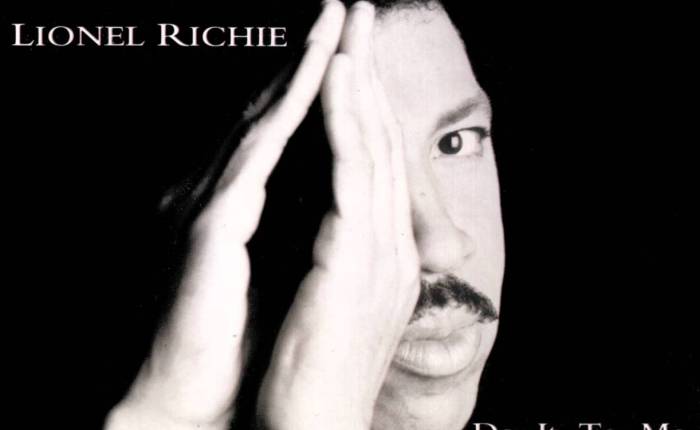
Michael Bay’s direction of Do It To Me is as good an example as any of this principle. The song clocks in at a modest 95 bpm, but the camera is constantly crashing between black and white and color, close and wide shots, women and men.

The thematic interest is paid to Richie, shot entirely in black and white, and his various female love interests, shot all in color. He is dressed simply in black, while she appears in a series of tantalizing gowns and flowing sheets. I suppose the video might have been “romantic” or even “sexy” to a person of the incredibly awkward early 90s, perhaps mostly because it sensualizes a set of black women in a sepia-based color palette that can’t have been common on television at the time.

Richie’s music is clearly white-people music. He was the whitest, yachtiest, soft-core-iest member of the otherwise funky Commodores, and he made a living clashing a jeri curl and a bushy mustache and overtly sexual lyrics with smooth, unthreatening sounds. He’s the type of black person America was comfortable with in 1992, as was Will Smith, a common component of Bay’s earlier films.

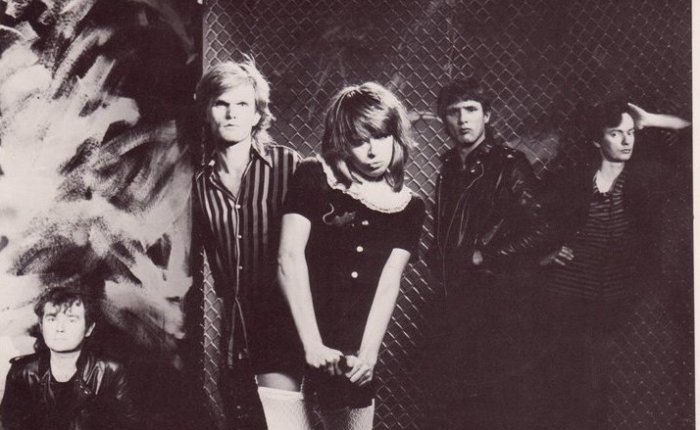
It’s tough to derive in hindsight whether Bay’s involvement with performers like this is an example of “pushing the envelope” within a society that we now look back on as pretty darn racist, or if he could have paid attention to more subversive or challenging black themes. His music videos consistently capture black artists playing white music (Richie), white artists playing black music (Vanilla Ice), otherness (The overt sexuality of the Divinyls, the bestial foreignness of Meatloaf), and strong women (Wilson Phillips).

Bay doesn’t seem like an envelope pusher when you look at his movies, but there is subversion to every one, from the complicated government / military themes in Bad Boys II and The Rock, to the symbolic, difficult love stories in Armageddon and Pearl Harbor.

In an era where America is challenged to confront whether they prefer a brash, challenging populist or an unexciting wonk who works within the system to get things done for President, it’s fun to think about the ways a mainstream movie director can tell us stories about the way we live our lives, especially when we aren’t overtly challenged to think about it.

He never has and probably never will stop making popcorn movies, but his work within the popcorn movie medium reminds me of the disrespect many people still give video games and comic books when they are referred to as storytelling devices. The medium outweighs the content.

Next: The Island

Every Michael Bay Movie, Part 10: Bad Boys II (2003)

Every Michael Bay Movie, Part 10: Bad Boys II (2003)

Bad Boys II – 2003

Budget: 130 Million

Box Office Gross: 273.3 Million

Rotten Tomatoes Score: 23

Explosions: 8


Bad Boys II is about America’s response to 9/11.

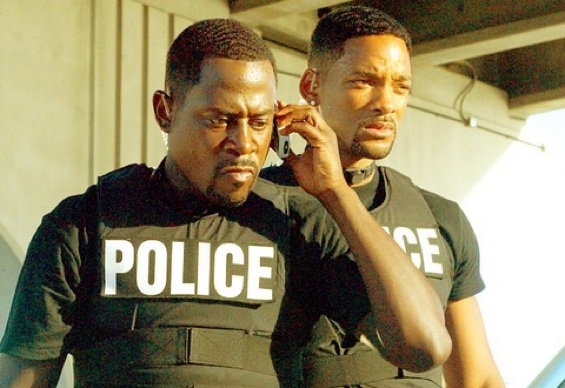
Listen, I don’t know if Michael Bay or screenwriters Rob Shelton and Jerry Stahl were thinking about 9/11 or the Iraq War when constructing the screenplay for the movie, or if Bad Boys II exists as an odd artifact of the culture and attitudes existing in America in the months immediately following the terrorist attacks. But as the plot and characters developed over the movie’s arbitrarily long 2-and-a-half hour run time I found myself thinking more and more about how Mike (Will Smith) and Marcus (Martin Lawrence) represent the attitudes held by Americans in 2002 and 2003 and how their actions can be seen as a scathing commentary on the way our country handled itself.

First of all, it’s an oddly paced amalgam of a movie that seems pieced together without regard for traditional storytelling techniques. The movie starts with a 30 minute action scene and never truly flows. It is full of homophobia, graphic violence, and an aversion to addressing emotional or mental issues. Racist jokes are featured prominently, as well as a morally inconclusive representation of the war on drugs. It is, if you’ll excuse my awkward application of logic where none may exist, very much like America: messy, ugly, often hateful, yet somehow beautiful in the diversity it represents.

There is also a protagonist problem. The movie lacks a real hero. Mike and Marcus definitely represent vastly different political worldviews. Mike spends the entire movie murdering witnesses and performing illegal searches. Marcus voices his concerns with these approaches but never really takes action to prevent them. The thing they have in common is that keep secrets. From each other, and from their families and friends.

While Mike ignores due process and manufactures evidence, Marcus is going through an emotional breakdown. He is more concerned with possibly becoming impotent than with the mission at hand. Even the impotence can be seen as a metaphor for the left’s ineffectualness when addressing the guttural nature of war and violence.

And when Marcus’ virility returns, the two immediately address their issues, embrace their own flaws, and remark on the fact that they can only be great when they are united.

“We ride together. We die together. Bad Boys for life.”

Other notes / evidence:

  • The movie begins with a violent confrontation with an extremist group which leads to one of our “heroes” being embarrassingly injured (he catches a bullet in the butt). Not quite a 9/11-level moment of violence, but a suggestion that the extreme response might have come from a position of humiliation rather than true and appropriate desire to catch any responsible parties.
  • The villains of the movie are Cuban, and it’s worth noting that, like Iraq and Afghanistan, Cuba has a complicated relationship with America primarily because of their association with Russia during the Cold War. Also, the Cuban gang leader murders a Russian gang leader about halfway through the movie.
  • Mike and Marcus’ “foreign” (hispanic) “allies” (another police duo) are consistently ambivalent about helping our heroes during the movie, primarily because of Mike and Marcus constant mistakes and refusal to follow the rules.
  • There is a scene near the beginning where the leader of an anti-narcotics police task force specifically mentions 9/11 when talking about America’s enhanced attention to international borders and drug trafficking.
  • The movie culminates in an action scene in Cuba, where, in an effort to get to Guantanamo Bay, they destroy an third-world-esque village filled with innocent civilians.

The movie is extremely technically impressive, especially the camera work, which features a lot of spinning, rotating shots. One scene in particular includes a camera orbiting a standoff, entering and exiting two rooms by weaving between characters and threading holes in walls, windows and doors. I’m still not sure how they did it. Another example, the aforementioned destruction of said third-world village, is beautiful, full of color and flying cloth and particle board and dirt and fast cars. But the casual violence toward civilians makes it feel a little less satisfying.

So I’m going to choose to believe that Bad Boys II, which came out in 2003, is an allegory about America’s reaction to a violent terrorist attack on its own soil. Because if it isn’t, it’s a poorly written, confusingly structured, unfunny action-comedy where you can’t relate to either of the heroes.

 Next: Lionel Richie!

Every Michael Bay Movie, Part 9: Pearl Harbor (2001)

Every Michael Bay Movie, Part 9: Pearl Harbor (2001)

Pearl Harbor (2001)

Budget: 140 Million

Box Office: 449.2 Million

Rotten Tomatoes Score: 25

Number of Explosions: 65


“If trouble wants me I’m ready for it. But why go looking for it?”

Writing about Michael Bay is difficult because his artistry is somewhat unrelated to whether his movies are bad. Armageddon is a great example of a mediocre movie where Bay’s excellent storytelling skills are on display. And it’s hard to think of another director who could have portrayed the titular scene in Pearl Harbor with such fearlessness and lack of sentiment.

Rafe and Danny come straight out of middle America, starting the film as young boys literally playing in a cornfield. They are the American pastoral dream. They are the life people talk about when they talk about the “the good old days.” Full of masculinity, imaginary violence, heterosexuality, and child abuse. It is no surprise, then, when Pearl Harbor ends with the isolationist character dying and leaving his interventionist counterpart to a life embodying the American spirit.

“Not anxious to die. Just anxious to matter.”

The movie traverses decades, countries, and languages, yada-yada-ing a majority of World War II but focusing earnestly on the relationship between Rafe, Danny, and the girl with whom they both fall in love.

Speaking of girls, the way Pearl Harbor treats women is incredibly offensive. The fact that every named female character in the movie is a nurse can be explained away, I suppose, by historical accuracy, but the fact that the only thing the female characters do is jabber to each other about how to meet men is off-putting and rings false next to the two male leads who are driven by honor and integrity and freedom. Kate Beckinsale plays the female lead, Evelyn, who pouts for a majority of the movie’s 3 hour run time in lieu of having a man on screen to motivate her.

So Pearl Harbor is generally trite, boring, and muddled. But the 45 minute scene portraying the Japanese attack on Pearl Harbor is one of the great action scenes I’ve ever watched.

You can debate Bay’s motives, or whether his worldview leads to interesting or effective stories, but he knows how to execute the significance of a moment. Especially a moment filled with action. He doesn’t shy away from complexity and captures the minutiae of a detailed and terrifying moment while still showing the broadest strokes.

Combining computer-generated graphics with fantastic photography and precise editing, the attack on Pearl Harbor is horrific, fascinating, and suspenseful. It feels fast-paced and electric but also dreadfully long. It feels inevitable due to the 90 minutes of slow pacing leading up to the moment of the attack, but also depressingly avoidable, due to the reactions of the various analysts and politicians who denied that the U.S. was vulnerable.

If Pearl Harbor was truly the story of Pearl Harbor, I think I would have liked it. The movie could have been an hour and a half, with a gripping action scene and minor exposition introducing us to the characters surrounding the event. We know Bay can direct effective, concise exposition because we saw it in Armageddon. Rafe and Danny serving as key protagonists as well as metaphors for America’s ambivalence about entering World War II would have worked as a guide for the audience through the events of the attack.

Instead, Pearl Harbor is a 2 hour love triangle where you never really get the sense that any of the characters are right for each other. And there is a long, out of place, interlude of an action scene.

It’s hard to believe that Michael Bay was that invested in the emotional core of this love story. But it’s worth remembering that 2001, the year of Pearl Harbor’s release, was at a peak moment in overlong love stories hidden in historical dramas. Titanic. The Last Samurai. And many more.

The thing I think makes Pearl Harbor so unwatchable, in the end, is the humorlessness of its subject matter. Bay’s movies are ridiculous. Armageddon, so obviously unscientific its premise, can be read as a comedy of errors and campy melodrama set in a disaster movie framework. The characters in The Rock are such exaggerated personalities that they captivate us in spite of their personal stories rather than because of them. And Bad Boys is just an out-and-out comedy. Pearl Harbor can’t be funny, and can’t even really be fun, because the subject matter is so morose, so it ends up feeling juvenile and vapid.

It’s also a movie that I think Bay had to try his hand at, similar to how Tom Cruise had to star in Born on the Fourth of July and Far and Away to realize he couldn’t succeed in a charmless drama, that he was Alec Baldwin instead of Daniel Day Lewis (speaking of which Alec Baldwin is pure gas in Pearl Harbor, playing the dickhole sales leader from Glengarry Glen Ross if he were a fighter pilot).

Bay needed to realize that he was not Steven Spielberg, despite their similarities in style. And his post Pearl Harbor choices largely denote a commitment to fun distractions. We need our distractions.

Next: Bad Boys II

Every Michael Bay Movie, Part 8: Armageddon (1998)

Every Michael Bay Movie, Part 8: Armageddon (1998)

Armageddon (1998)

Budget: $140 Million

Box Office Gross: $553.7 Million

Rotten Tomatoes Rating: 39

Number of Explosions: 14


“I don’t know what you people are doing down there. But we got a hole to dig up here.”

The thing I found most interesting about Armageddon was the attention paid to the distance between the characters from each other. The distance between the asteroid and earth. The emotional distance between Grace and her father. The distance between A.J.’s crash-landed shuttle and the other space shuttle manned by Harry. And throughout the film, characters say things like,

“Do you think it’s possible that someone else in the world is doing this very same thing at this very same moment?”

“Why are you listening to someone 100,000 miles away? We’re here.”

Armageddon remarks on closeness and asks, to return to the themes of Michael Bay, what motivates people to do what they do.

But you probably don’t think of Armageddon that way. You probably think of it as a stupid, mindless action movie riddled with plot holes and emblematic of the summer movie culture, shat out by Hollywood entire to cash in on mindless dupes who just want somewhere air-conditioned to eat their popcorn.

And you know what? You have a point. You know that scene in every action movie in which everything doesn’t quite go to plan? Armageddon asks, “what if we made an entire movie out of that moment?” Things go awry, from the first scene on an offshore oil rig to the final moment, and for every moment in between for 3 hours. It’s exhausting to watch.

I’ve never really been compelled by arguments that point out scientific or logical inconsistencies in a movie plot. Each movie has to create a set of events and characters that exist in imagination rather than in reality, otherwise they’d all be documentaries. And in a fictionalized world of a movie the writers can create anything they want, for all I care. With respect to the famous criticism of Armageddon: couldn’t they have just trained a team of astronauts to drill, rather than train a team of drillers to astronaut? This is actually addressed in the plot of the movie. In the Armageddon universe, it is so hard to drill that it’s actually easier to train the drillers to go into space. Who cares if this is true in reality?

On the other hand, a disaster movie like Armageddon has to be based in some sense of reality because the entire premise is to make us as an audience imagine the dread of a world-ending event like a meteor hitting the earth. From that perspective it has to have more in common with the real world than Star Wars or one of those Marvel movies. And there are so many things in Armageddon that feel purely imagined that it makes it hard to focus on what is happening in the movie itself.

Yet, Armageddon has some things going for it – and most of those things can be attributed to Michael Bay.

First of all, Bay finds out how to squeeze tons of exposition into just a few minutes of screen time in order to focus a majority of the film on action. There’s the scene on the oil rig, which has its own bit of action, when we learn about Harry Stamper (Bruce Willis) and his crew, and A.J. (Affleck) and his relationship with Grace (Liv Tyler), Harry’s daughter. There is a one or two minute scene where Stamper gathers his entire team of drillers in a montage that tells us about who they are and what they like to do with their spare time. Then there’s another minute or two where we see A.J. and Grace together. That’s about it.

Yet the critical mission of the film’s plot takes off merely halfway through the movie and we spend a majority of the film watching the events in space. And as an audience we need to care about those moments we spent with the characters earlier in the film because we need to want A.J. to make it home to Grace. And we need to feel Harry’s sacrifice when he chooses to stay behind spoiler alert and detonate the bomb.

Does it work? Probably not for everyone. A critic would say that all of those action twists and turns could have been better spent establishing character. But the script has so much to chew through, and Armageddon is about watching our working class heroes overcome adversity in one situation after another.

The other thing that I noticed when watching Armageddon (which I last saw in a movie theater with my first girlfriend when I was 13 years old) was how important color was to this movie. I don’t know that the color is supposed to signify anything but there is a great deal of creativity employed with the lighting in Armageddon to create scenes that are doused in striking color. In the scene where Harry convinces Grace that he needs to go into space to solve this problem, Willis is somewhat normally lit, but Tyler’s frame is completely colored in green. In the moment you don’t think much of it because it’s probably some special space command light in the NASA terminal, but it’s an odd and abstract choice for a personal moment between two characters.

The Asteroid itself, computer generated and ominous, is generally surrounded by a purple hue. In fact, space itself is quite starkly lit in Armageddon, perhaps a nod to the otherworldliness of the setting, or perhaps a trick used to make a set look less, well, set-like. This use of color is remniscient of Divinyls’ I touch myself video (previously reviewed here) which also addresses the alien-ness that can be represented by color.

The use of color is key. It may not indicate an underlying lesson, but it does signify craftsmanship. It is a choice that didn’t have to be made when the movie was directed, edited, and shot. And stark differences in color and light typically symbolize other-ness. The theme of distance mentioned above is crucial.

What is more important? Physical distance or emotional distance? How is closeness developed? What kind of connection do people have when they are miles apart? Armageddon suggests that closeness means more than distance, and that there is a force in the universe more important than space and time. Remember 2015’s Interstellar, directed by the acclaimed Christopher Nolan? Is Armageddon really worse than that? Or was it just created by a more derided artisan?

So you may not like Armageddon, plot holes and all, but if you don’t, I think it’s likely that you should blame the writers instead of Michael Bay, who did in fact employ some artfulness in creating it. You know who was on the writing team? Sci-Fi wunderkind J.J. Abrams (who in my opinion still hasn’t written a satisfying movie).

Anyway, It is not always a joy to watch, but it isn’t stupid. And that’s the thing I am curious about. How did Michael Bay get characterized as a director of mindless cinema?

Next: Pearl Harbor
Every Michael Bay Movie, Part 7: The Rock (1996)

Every Michael Bay Movie, Part 7: The Rock (1996)

The Rock – 1996

Budget: $75 Million

Box Office Gross: $335.1 Million

Rotten Tomatoes Rating: 66

Number of Explosions: 6


“It’s on a need to know basis. And you don’t need to know.”

Every character in The Rock is keeping a secret from others. And every character in The Rock is having information withheld from them. The plot, each character arc, and the theme of the movie cover the power and authority that come with holding information that others lack.

Ed Harris’ General Hummel threatens to release chemical weapons in San Francisco, killing millions. The audience knows that he doesn’t intend to hard anyone. But the threat of danger is his secret, and the secret is what gives him power.

Hummel’s motivation? Frustration that the USMC won’t pay reparations to families of Marine special operatives who died performing secret missions. Harris’ knowledge of the secrets of these operatives is what makes him take extreme actions.

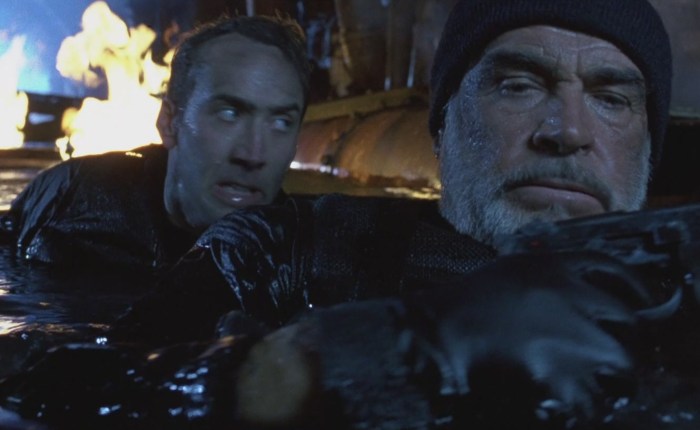
Every character has a secret agenda. Nic Cage’s Stanley Goodspeed constantly lies, to his girlfriend, to his counterpart John Mason (played by Sean Connery), and later to the FBI about Connery’s fate. These lies give him the free will to act as he chooses. When he is at risk of being found out, like when he tells the obvious lie that he has combat and anti-terrorism training, he is in danger of retribution. But as long as he maintains his secrets he is powerful, as powerful as if the lie were true.

Again we come to the difficult intersection of the director and the long list of specialists who work on a movie. The Rock is expertly written by Douglas Cook and David Weisberg and they are the ones who put these motivations into the minds of their characters as well as the words that help the audience understand them. But Bay is the one who chooses how and when to reveal these motivations, through staging and dialog and imagery. Again, never the one for subtlety, he shows a character’s pants literally catching on fire at one point. But he also shows Harris’ struggle with maintaining his threat while carefully avoiding hurting anyone.

Bay interned briefly for Steven Spielberg on the set of Raiders of the Lost Ark*, (and famously thought the movie was going to be terrible) and seems to have picked up a lot from Spielberg’s storytelling methods. While Bay is not sentimental in the same way Spielberg is, their technical approach to showing the characteristics of a scene are quite similar.

*By the way, check out Steven Soderbergh’s beautiful version of Raiders which has been stripped of all sound and color and re-scored to the electronic music used in Soderbergh’s television show The Knick. It is surprisingly engaging and not at all hard to follow even without any dialog. A great study in composition and visual storytelling. 

What we interpret as scenes and pictures with our minds are actually a series of pictures. When you look at the something your eye is rapidly and constantly scanning the surroundings and taking snapshots and your brain pieces the snapshots together to create what you interpret as an image. Some filmmakers choose to leverage this natural capability of the human brain by creating complex painting-like compositions that describe an entire scene in a single picture. Think of George Miller’s Mad Max: Fury Road where each frame is a tremendously complex and beautiful work of art.

Michael Bay (and to an extent, Spielberg) take more of an abstract approach, replicating your eye/brain process by actually showing you each individual chunk that makes up a larger scene. In a Michael Bay action scene, or even in a conversation, the camera is constantly showing you new things. A close up of a character. A piece of scenery. An object. The space between characters. A different angle. Another angle. Light pouring in from a window. You get a sense of space and time and motion that doesn’t exist in any single frame but does exist as a composition of shots. This is purist filmmaking.

This is a decidedly less “beautiful” approach than employing a cinematographer to capture intensely focused and massive establishing photographs and each picture fails to take your breath away. But it is a wonderfully effective way at telling a story that respects time as well as space in a medium like film. Bay is an excellent communicator and whether he knows it theoretically or not he has a precise understanding of how humans like their information paced and distributed to best understand a moment.

This expert dispersal of knowledge is almost a meta-narrative when combined with The Rock‘s themes of knowledge and authority. The skill would rarely be described as an art but  the amount of technical and intellectual expertise required to master it is truly artistic in nature. Note that the heroes of The Rock are masters of knowledge – Goodspeed because of his expertise relevant to the diffusion of the film’s chemical McGuffins, and Mason whose entire life has been about spycraft and access to hidden information.

People who succeed are those who have special knowledge that no one else has. When others learn their secrets, they can be threatened. A surprisingly topical lesson considering 2016’s issues of privacy, disclosure, and access to information.

“Losers try their best. Winners go home and fuck the prom queen.”

Next: Armageddon

Every Michael Bay Movie, Part 6: Bad Boys (1995)

Every Michael Bay Movie, Part 6: Bad Boys (1995)

Bad Boys – 1995

Budget: $19 Million

Box Office Gross: $141.4 Million

Rotten Tomatoes Rating: 43

Number of Explosions: 4


“I make movies for teenage boys. Oh dear, what a crime” – Michael Bay

Bad Boys is a great example of why I think Michael Bay is an interesting filmmaker. It is remembered mostly as an action/comedy that launched Will Smith’s career as a leading man. And while there is plenty of action it is decidedly less action-y than I would expect based purely on Michael Bay stereotypes. In fact, for most of the movie, the action is intentionally muted.

While there are a fair number of scenes where characters are shooting at one another, you rarely see a gun actually go off. The action is loud and the screen is full of smoke and flashes and different camera angles, but the explosion emanating from the barrel of the movies many rifles, shotguns, and pistols is nowhere to be seen (at least for the movie’s first 90-or-so minutes – at the end there is an extensive shoot out where all bets are off with respect to violence and weaponry. But even then there is less on-screen violence than you might expect).

I think this is clearly an intentional decision. Which is why it’s important to digress briefly to talk about what a director of a movie does:

The director of a movie does everything, but also nothing. They are in charge of all of the elements of the film’s creation, but work through a variety of specialists. Cinematographers, Editors, Lighting Technicians, etc all execute the specific tasks associated with a movie’s production but the director creates the vision and also makes sure the final product adheres to that vision. They also manage the actors and try to assure that the screen performances match their imagination of the movie’s script.

Because of this, it’s difficult to know whether cutting away from the true firing of guns in Bad Boys was part of Director Bay’s vision or not. It could be something that the editor did for some reason, or if they had a major shortage of ammunition on set and couldn’t get budget for more blank rounds, or if there was a licensing issue on the set they rented that prohibited firing weapons, or something else. It’s also worth noting that this was Michael Bay’s first feature film, and Jerry Bruckheimer was probably managing the production pretty closely, so some of the decisions could be credited to Jerry rather than our friend Mike.

But back to this anomaly in Bad Boys; I think it is quite notable because Bay has such a reputation for sacrificing story and artistry in favor of bold action set pieces and in this movie there is a clear pulling of punches when it comes to weapon use. Also notable – Julie, played by Tea Leoni, is passionate about animal rights and mentions her vegetarianism and reluctance to hurt animals multiple times. The character note is unrelated to anything else that happens in the movie but it does fit with an underlying thread of humanism also backed by the films reluctance to show violence head-on.

In fact, most of the movie consists of various characters bickering with each other. There is so much arguing in this movie that it is almost grating. A couple of times I found myself wincing at how uncomfortable I was watching two characters yell at each other. Is it an attempt at comedy?

Bad Boys is not the first movie to use the Odd Couple shtick to carry the plot. There is also a Trading Places element when Will Smith and Martin Lawrence swap lives based on a Three’s Company style misunderstanding about who is whom. The movie is full of strained relationships between characters that don’t dislike each other and understand where their counterparts are coming from but still clash because of conflicting motives.

You could credit this to bad writing. But I think what you’ll find as you watch Bay’s movies is that there is a clear, focused fascination with what motivates people.

In the same way that Tom Cruise’s personality and motivations can be derived from looking at his choices in starring roles, costars, and the content of his performances, Michael Bay’s interests and principles can be deduced from looking at the trends in his movies. Does he like to see things explode? Of course he does. Who doesn’t?

Does Michael Bay accept a new filmmaking project by thinking “how does this movie help me reveal bold new truths about relationships and the human condition?” Probably not. But one of the principles of criticism is that texts mean what they mean regardless of what the author was thinking when he or she created them. And Michael Bay’s texts are about what makes people do what they do.

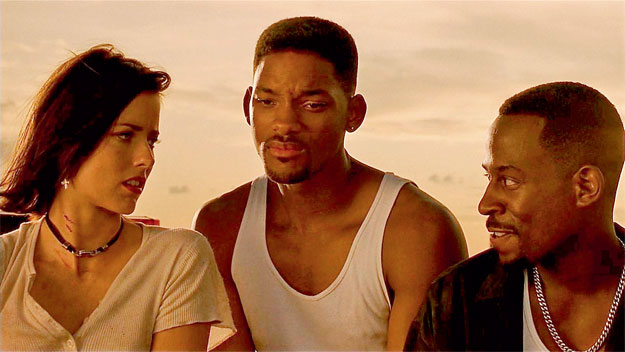
Bad Boys is about what motivates partnerships between people. Martin Lawrence (Marcus) and Will Smith (Mike). Marcus and his family. Mike and Martin’s family. Marcus and Julie, played by Tea Leoni. Marcus and Mike’s boss and a woman from Internal Affairs. Even the criminal antagonists constantly fight amongst themselves while they are working toward a shared goal.

Bay only resorts to theme when he can slam it directly in our collective faces. So the fact that this type of relationship is played so consistently in Bad Boys means something.

For true conclusions. We need to go deeper into his repertoire. Next up: The Rock

Every Michael Bay Movie, Part 5: Meat Loaf, I Will Do Anything For Love (1993)

Every Michael Bay Movie, Part 5: Meat Loaf, I Will Do Anything For Love (1993)

“I have traveled across the universe through the years to find her. Sometimes going all the way is just a start.”

This is an extremely Michael Bay song. The opening chord is played by a motorcycle engine. It is decidedly hardcore, full of images of hell and violence. Yet it is a singularly sentimental song, focusing more on personal emotion than the violence it describes. Bay’s feature movies will mirror this focus.

Bay’s video juxtaposes Mr. Loaf’s world of demonic imagery, religious symbols and smoke with a modern motorcycle and helicopter world where men in suits hunt down a lonely transgressive monster trapped in the past.

It is, like all of Bay’s work, devoid of symbolism outside of what can immediately hit you in the face. But here it works to showcase the loneliness in feeling unable to win at love because you can’t change who you are. There is no silver bullet, no secret “that” in the underlying meaning of the song, simply “that” which you cannot do because you will never be able to do it sufficiently. Because you are not the right person, and you never will be.

In other words, this is a fucking great music video. Is it the best thing Bay has ever directed? It’s possible.

Next up: Bay’s feature film career begins

Every Michael Bay Movie, Part 4: Wilson Phillips, You Won’t See Me Cry (1992)

Every Michael Bay Movie, Part 4: Wilson Phillips, You Won’t See Me Cry (1992)

I have to admit, I don’t hate the super-cheesy soft rock of the late 1980s and early 1990s. But this is a fantastic example of why the genre is, to so many people, so hateful. Terrible smooth jazz saxophone, floor toms pounding and echoing as the music reaches its climax, sentimental and saccharine melodies. And lots and lots of white people.

In fact, at this point of his early career, Michael Bay was a champion of cheese. There are no explosions to be found in any of his videos, just white people complaining and celebrating their privilege.

There are some consistencies that one can point to in Bay’s music videos that could be his personal stylistic ticks, or they could just be indicative of the general style of the era. The black and white and color switching is here again, but unlike in the Divinyls video, it just seems pointless here.

To be honest this video is just complete garbage and could easily be replaced by a slideshow of stock footage models looking longingly into the distance.

It’s not much of a surprise considering this that Bay’s films are filled with exploding cities. If this is the culture that he was a party to as he came of age, he was right to want to see it destroyed.

Every Michael Bay Movie, Part 3: Divinyls, I Touch Myself (1991)

Every Michael Bay Movie, Part 3: Divinyls, I Touch Myself (1991)

I Touch Myself is a catchy yet simplistic song with an overt sexual theme. It is not subtle; it does not suffer such high arts as symbolism or metaphor. Chrissy Amphlett is talking about literally touching herself, and we all know the social and cultural impositions to which she is referring.

Bay’s video is riddled with like non-subtleties. Lilies. Fainting Sofas. Poles in close proximity to women’s faces. Close-ups of cleavage. Georgia O’Keefe could have directed this video.

The film alternates between black and white and color, the color segments overlit and bright with purple, gold, and Amphlett’s striking red hair. In some music videos an oscillation between greys and color might indicate different realities – a dream sequence, a flashback, or even a fantasy.

But here the entirety is a fantasy – lurid, sexual, and loud. So lucidly presented, in fact, that the overt sexuality loses is sex appeal. A topic that should feel risqué feels desperate.

By the end of the song, you realize that the singer knows how silly she sounds. She is either so hopeless that she must make her desperation known to the world, or so mutually in love that she wants to shout it to whoever will listen. Her sexual need is a cartoon, and this is the perfect video for it.